
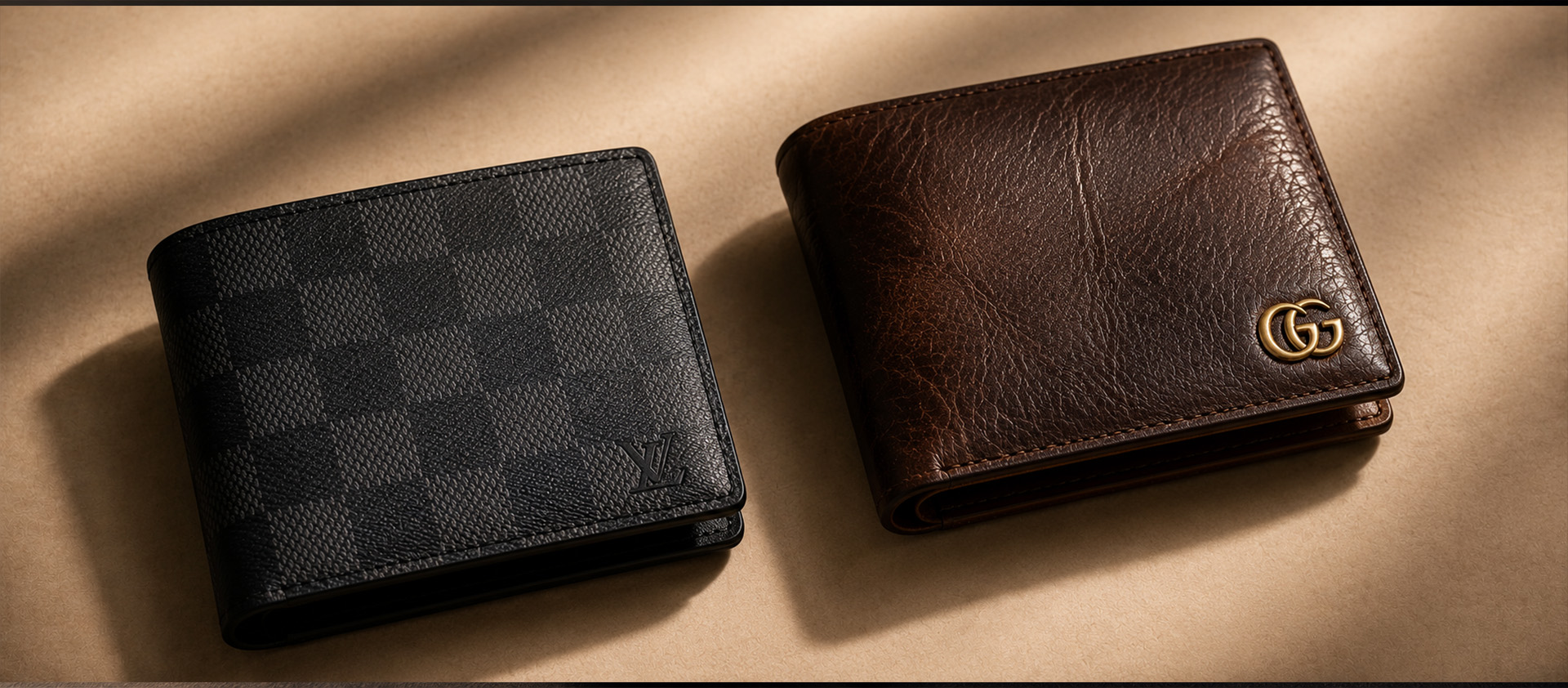
Genuine Leather vs Synthetic Leather Wallets: Buying Guide
- Published on: 23 Jul 2026
- Wallets
The Wallet Material Question Everyone Asks
“Is this real leather?” — It’s one of the most common questions asked before buying a wallet. And the answer matters, because the material affects how long the wallet lasts, how it feels in your hand and pocket, and how it looks after years of daily use.
But here’s the thing: the leather conversation has evolved significantly. Modern synthetic leather (particularly high-quality PU leather) has become genuinely competitive with genuine leather in many categories — and in some cases, superior. Understanding the differences helps you make the right choice for your needs and budget.
This guide covers everything: the different leather types, how to identify them, how they compare for wallets specifically, and which is right for you.
First, Let’s Clear Up the Leather Hierarchy
Not all “leather” is the same. Here’s the full hierarchy from highest to lowest quality:
Full-Grain Leather (Best)
The highest quality leather available. Made from the outermost layer of the hide with the grain (natural surface) completely intact. Characteristics: - Natural grain pattern visible — no two pieces identical - Develops a beautiful patina over time (darkens and softens with use) - Most durable — resists moisture and wear better than processed leathers - May have small natural marks (scars, insect bites) — considered premium character - Price: Highest
In wallets: Full-grain leather wallets improve with age. The patina makes each wallet uniquely personal. These are heirloom pieces.
Top-Grain Leather (Common Premium)
Made from the same hide layer as full-grain, but the surface is sanded and a finishing coat applied to remove natural imperfections. Most luxury wallets use top-grain leather. Characteristics: - Smoother, more uniform surface than full-grain - Still very durable — good for 5-10 years of daily use - Develops some patina, but less dramatically than full-grain - More consistent appearance - Price: High-mid
In wallets: The standard for quality genuine leather wallets. Gucci, Louis Vuitton, and Coach use variations of this for their leather wallets.
Genuine Leather (Mid-Tier)
A confusing term — “genuine leather” sounds premium but is actually a mid-lower tier. Made from the layers of hide remaining after top-grain is separated; often sanded and spray-coated to look uniform. Characteristics: - Less durable than full-grain or top-grain - Surface coating can peel over time - Uniform appearance - Price: Mid-range - Important: “Genuine leather” on a label doesn’t mean high quality — it means it’s technically animal leather, but from lower-grade material
Bonded Leather (Lowest “Real” Leather Tier)
Scraps of leather ground up and bonded with polyurethane on a paper or fiber backing. Characteristics: - Looks like leather initially - Peels, cracks, and delaminate within 1-3 years - Not recommended for wallets expected to last
Tip: If a wallet is priced very cheaply and labelled “genuine leather,” it’s likely bonded leather.
Synthetic Leather: Not All Equal
PU Leather (Polyurethane Leather) — The Quality Tier
The highest quality synthetic leather. Made by coating a fabric backing (usually polyester) with a layer of polyurethane. Characteristics: - Soft, consistent texture - More water-resistant than most genuine leathers - Doesn’t develop a patina (looks same throughout lifespan) - Good durability — 3-5 years with quality manufacturing - Animal-free (important for vegan buyers) - Price: Low-mid
In wallets: High-quality PU leather wallets are used extensively in the first copy market and some genuine fashion brand accessories. When well-manufactured, they’re excellent for daily use.
PVC Leather (Vinyl Leather) — The Entry Level
Plastic-based synthetic with a leather-like texture coating. Less breathable than PU. - Stiffer feel - Less durable than PU - Can crack in temperature extremes - Price: Low
Microfiber Leather — The Alternative Premium Synthetic
A more advanced synthetic using microfiber non-woven fabric base with a PU coating. Creates a closer feel to genuine leather than standard PU. - Soft, breathable, and flexible - Good durability - Higher quality feel than standard PU
The Head-to-Head Comparison: Genuine vs Synthetic Leather for Wallets
Durability
Full-grain/Top-grain genuine leather: Exceptional. A quality full-grain wallet lasts 10-20+ years with minimal care. The leather strengthens with use.
Quality PU leather: Good. 3-5 years of daily use typically; up to 7-10 years with careful use. The main failure mode is delamination at flex points.
Bonded leather: Poor. 1-2 years before visible peeling and cracking.
Verdict: Full-grain wins definitively. Quality PU is a solid second place — better than bonded or lower-tier genuine leather.
Feel & Texture
Full-grain genuine leather: Warm, slightly textured, develops a personal feel over time. Most people describe it as “organic” — responds slightly to temperature and moisture.
Quality PU leather: Cool, uniform, consistent. Slightly more plastic-feeling than genuine leather, though premium microfiber PU is very close to the real thing.
Verdict: Genuine leather wins on feel for those who appreciate natural materials. PU is entirely acceptable for most buyers.
Water Resistance
Genuine leather: Natural leather absorbs moisture — it can be conditioned and treated to improve water resistance, but it’s inherently vulnerable to water staining and prolonged moisture exposure.
PU leather: Naturally water-resistant — the polyurethane coating repels moisture effectively.
Verdict: Synthetic leather wins. This is one area where PU is genuinely superior for everyday use.
Appearance Over Time
Full-grain genuine leather: Improves dramatically — develops rich patina, darkens elegantly, becomes more characterful.
Quality PU leather: Stays consistent in appearance. No patina development. May show surface wear at flex points after extended use.
Verdict: Genuine leather wins if you appreciate aging and character. PU wins if you prefer consistent appearance.
Maintenance
Genuine leather: Requires periodic conditioning (leather cream or oil) to prevent drying and cracking. Needs to be dried properly if it gets wet. Stains can be challenging.
PU leather: Low maintenance. Wipe clean with damp cloth. No conditioning needed.
Verdict: Synthetic leather wins on convenience.
Ethics & Environment
Genuine leather: Animal-derived. Environmental concerns include tanning chemicals and animal welfare.
PU leather: Animal-free. However, it is petroleum-derived plastic and not biodegradable.
Verdict: Depends on your priorities. Neither is without environmental concern.
Price
Full-grain/Top-grain genuine leather: ₹1,500-₹20,000+ for branded options
Quality PU leather: ₹500-₹5,000 for most daily-use and first copy options
Verdict: Synthetic leather wins on price accessibility.
Which Is Better for First Copy Wallets?
In the first copy wallet market, quality PU leather is the most common and practical material choice — for good reason:
1. Water resistance — daily use puts wallets through rain, hand contact, and pocket moisture; PU handles this better
2. Consistency — uniform appearance across all first copy units (critical for branded designs)
3. Price efficiency — allows quality branding and construction at accessible prices
4. Pattern application — monogram and logo patterns (LV, GG) bond better to PU surfaces
A quality first copy wallet in good PU leather will: - Look great from day one - Maintain consistent appearance throughout its lifespan - Hold up to daily pocket use for 2-4 years - Resist water and light moisture damage
The tradeoff: no patina development, and the material won’t improve with age like full-grain leather does.
Quick Identification Guide: How to Tell Real from Synthetic
Visual Tests
• Natural leather: Slight natural grain variation; no two areas identical
• Synthetic: Perfectly uniform texture pattern; exactly repeating grain
Smell Test
• Natural leather: Distinctive organic leather smell (hard to describe but instantly recognisable)
• Synthetic: Slight plastic or chemical smell when new; neutral after airing
Burn Test (for material samples only — not the wallet!)
• Natural leather: Burns slowly, smells like burning hair
• Synthetic: Melts rather than burns, smells like burning plastic
Flex Test
• Full-grain: Flexes smoothly without cracking; returns to shape
• Bonded leather: White stress lines appear when flexed; may crack at flex points over time
• Quality PU: Flexes smoothly, consistent throughout
Absorption Test
• Natural leather: A small drop of water will slowly absorb into untreated leather
Synthetic: Water beads and runs off the surface
Who Should Choose What?
Choose Genuine Leather (Full-Grain or Top-Grain) If:
• You want a wallet that improves with age and develops personal character
• You’re making a long-term investment piece — 10+ years
• You appreciate natural materials and are willing to maintain them
• Budget is secondary to longevity
Choose Quality PU Leather If:
• You want reliable, consistent daily performance
• Budget is a priority
• You’re looking for a quality first copy branded wallet
• You prefer low-maintenance accessories
• Water resistance in everyday situations is important
• You change wallets every 2-4 years by preference
Avoid Bonded Leather:
Unless the price is so low that you’re treating it as a temporary wallet (under ₹300), bonded leather will disappoint. The peeling and delamination within 1-2 years is frustrating.
Caring for Each Wallet Type
Genuine Leather Wallet Care
Monthly: - Empty wallet completely and wipe with dry soft cloth - Check for signs of drying (loss of natural sheen, stiffness)
Every 3-6 months: - Apply a thin coat of leather conditioner (Leather Honey, Cadillac, or any quality leather cream) - Buff gently with soft cloth after 30 minutes
If it gets wet: - Dry at room temperature — never with heat (hair dryer, radiator) - Condition after it dries completely
Storage: - Keep in a cotton dust bag or soft wrap if storing long-term - Away from direct sunlight — UV fades and dries leather
PU Leather Wallet Care
Regular: - Wipe with slightly damp cloth to remove dirt and oils - Avoid harsh cleaning chemicals — mild soap solution if needed
Avoid: - Prolonged sunlight exposure — PU can discolor and harden - Extreme heat — can cause delamination - Abrasive materials — can scratch the surface coating
Frequently Asked Questions
Is PU leather good quality for wallets?
Quality PU leather is an excellent wallet material — water-resistant, durable for 3-5 years, low maintenance, and visually attractive. For everyday daily-use wallets, it competes well with mid-tier genuine leather.
How long does a genuine leather wallet last?
A quality full-grain or top-grain leather wallet can last 15-20+ years with proper care. A mid-tier genuine leather wallet typically lasts 5-10 years. Bonded leather lasts 1-3 years.
Can you tell the difference between real and fake leather wallets?
To an untrained eye and touch, quality PU leather and top-grain genuine leather can be difficult to distinguish. The tell-tale differences are: the smell (genuine leather has a distinctive organic scent), the long-term aging behavior (genuine leather develops patina), and close examination of the texture pattern (genuine leather has natural variation).
Is it worth spending extra on a genuine leather wallet?
For a wallet you plan to carry every day for 10+ years and want to develop personal character over time — yes, genuine leather (full-grain or top-grain) is worth the investment. For a 3-5 year daily wallet, quality PU leather delivers excellent value.
Recommendation
The right material depends entirely on your priorities:
• Long-term investment + character appreciation = Full-grain/Top-grain genuine leather
• Daily performance + value + low maintenance = Quality PU leather
• Avoid at all costs = Bonded leather
For first copy branded wallets, quality PU leather is the standard — and a well-chosen first copy wallet delivers branded aesthetics, reliable daily performance, and excellent value for 2-4 years of use.
At WatchNGlasses, our first copy accessories including wallets are selected for material quality specifically — because the best-looking wallet in the world isn’t a good buy if it falls apart in six months.
Explore Our Collections: - First Copy Accessories - First Copy Handbags - First Copy Watches - Contact Us
You May Also Like
Related Blogs
First Copy vs Original Products: Key Differences Explained
What Is a First Copy Product? A first copy product is a high-quality replica manufactured to closely replicate the design, a...
Read More →
The Ultimate Guide to Choosing Your First Copy Leather Wallet
Why Your Wallet Matters More Than You Think Your wallet is one of the most-touched accessories you own. You reach for it doz...
Read More →
Best Wallets for Men: Functionality, Style, and Durability
A wallet is one of the few accessories a man uses every single day — yet it’s often an afterthought. The right wa...
Read More →