
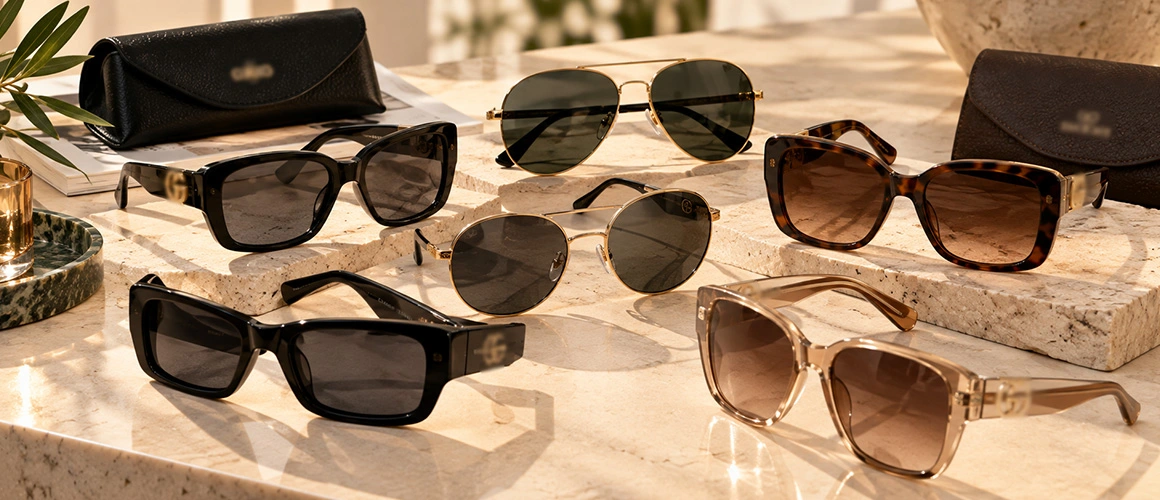
How to Choose the Right Sunglasses: A Complete Buying Guide
- Published on: 28 Oct 2026
- Sunglasses
Sunglasses are eyewear first, fashion second
Most of us pick sunglasses the same way: try a few on, check the mirror, buy the pair that looks best. Looks matter, but that approach skips the one thing sunglasses are actually for, which is protecting your eyes.
In India, where the sun is strong for most of the year, that matters more than you might think. The right pair cuts glare on the drive to work, makes beach days comfortable and protects your eyes for decades. The wrong pair can do more harm than going without.
This guide walks you through five steps, in the order that matters: protection, face shape, lenses, frame and fit, and how you'll use them.
- Protection first: buy only sunglasses labelled UV400 or 100% UV protection. Darkness and price say nothing about UV protection.
- Face shape: pick a frame that contrasts with your face. Angular frames for round faces, rounded frames for square faces.
- Polarised lenses cut glare from roads and water. They're great for driving and the beach, but polarisation is not the same as UV protection.
- Lens colour: grey keeps colours natural, brown and amber boost contrast, green is a balanced all-rounder.
- Fit: the frame should cover your eyes fully, sit close to your face, and not slide down when you look down.
Step 1: Check UV protection before anything else
UV protection is the only feature that truly protects your eye health. Everything else is comfort or style.
What the labels mean
|
Label |
What it means |
Buy? |
|---|---|---|
|
UV400 |
Blocks UV rays up to 400 nanometres, covering both UVA and UVB |
Yes, the label to look for |
|
100% UV protection / UV 95–100% |
Blocks almost all UV |
Yes; ideally it should also say UV400 |
|
"UV protection" with no number |
Unclear; could be partial |
Check further or skip |
|
No UV label |
May be just tinted plastic |
No |
One detail worth knowing: Columbia University ophthalmologist Dr Tongalp Tezel notes that some "100% UV" claims only cover light up to 380 nm, so UV400 is the safer label to look for (ColumbiaDoctors).
Three myths that cause bad purchases
- "Darker lenses protect more." They don't. Dark lenses without UV protection are actually worse than no sunglasses, because your pupils widen behind them and let more UV reach the back of the eye (MD Anderson).
- "Polarised means UV-protected." It doesn't. Polarisation only cuts reflected glare. UV protection is a separate feature, so check for both.
- "Expensive means safer." It doesn't. An affordable pair with a UV400 label protects just as well as a designer pair.
Why it matters
Long-term UV exposure is linked to cataracts, pterygium ("surfer's eye", an overgrowth on the eye's surface), photokeratitis (a painful sunburn of the eye) and cancers of the eyelid (MD Anderson). These develop slowly, which is why protection from a young age matters. Children's eyes let in more UV than adults', so kids need UV400 sunglasses too.
Step 2: Match the frame to your face shape
The rule is contrast. A frame that mirrors your face shape exaggerates it; a frame that contrasts with it creates balance.
How to find your face shape: pull your hair back, stand in front of a mirror and trace the outline of your face on the glass with soap or a dry-erase marker. Compare the width of your forehead, cheekbones and jaw, and the overall length.
|
Face shape |
How to spot it |
Frames that suit you |
Frames to avoid |
|---|---|---|---|
|
Round |
Soft jaw, width and length about equal |
Rectangle, square, wayfarer, geometric |
Small round frames |
|
Square |
Strong jawline, broad forehead |
Round, oval, aviator, browline |
Boxy, sharply angular frames |
|
Oval |
Slightly longer than wide, balanced features |
Almost any style; try oversized or wayfarer |
Frames much wider than your face |
|
Heart |
Wide forehead, narrow chin |
Aviator, round, rimless, light-bottomed frames |
Heavy top-bar or decorative brow frames |
|
Long / oblong |
Noticeably longer than wide |
Oversized, wraparound, deep frames |
Narrow, small lenses |
|
Diamond |
Wide cheekbones, narrow forehead and jaw |
Cat-eye, oval, browline |
Narrow frames |
For women: cat-eye and oversized frames are especially flattering on heart, diamond and oval faces. For men: aviators and wayfarers are the safest two styles; between them they suit most face shapes.
If you already love a particular frame that "breaks the rule", wear it anyway. These are starting points, not laws.
Step 3: Choose the right lens type and colour
Lens types
|
Lens type |
What it does |
Best for |
Trade-off |
|---|---|---|---|
|
Standard tinted |
Reduces brightness |
Everyday wear |
Doesn't cut glare |
|
Polarised |
Blocks horizontal glare reflected off roads, water and glass |
Driving, beach, fishing, snow |
Can make phone and car LCD screens hard to read |
|
Mirrored |
Reflective coating reduces light entering the lens |
Very bright conditions, fashion |
Scratches more easily |
|
Gradient |
Dark at the top, lighter at the bottom |
Driving (clear dashboard view), city wear |
Less protection from glare below |
|
Photochromic |
Darkens in sunlight, clears indoors |
People who switch indoors and outdoors often |
Darkens less inside a car |
Quick polarisation test: look at your phone screen through the lens and slowly rotate the sunglasses. If the screen goes dark at one angle, the lens is polarised.
Lens colours
|
Lens colour |
What it does |
Best for |
|---|---|---|
|
Grey |
Reduces brightness evenly, keeps colours natural |
Everyday wear, driving in bright sun |
|
Green |
Balanced contrast and natural colours |
All-round use, the classic "G-15" look |
|
Brown / amber |
Boosts contrast and depth |
Cloudy days, cricket, golf, driving |
|
Yellow / orange |
Sharpens contrast in low light |
Overcast days, dusk; not for bright sun |
|
Rose / red |
Increases contrast, soothing tint |
Fashion, light outdoor sports |
|
Blue / purple |
Mostly cosmetic, reduces glare in haze |
Fashion |
If you're buying just one pair, grey or green is the safest choice. Avoid wearing any tinted lens after dark, including yellow "night driving" lenses; every tint reduces the light reaching your eyes.
Step 4: Pick the frame material and get the size right
Frame materials
|
Material |
Feel |
Pros |
Cons |
|---|---|---|---|
|
Acetate |
Thick, glossy, premium |
Rich colours, sturdy, adjustable with heat |
Heavier |
|
Metal (stainless steel, alloy) |
Thin, minimal |
Classic aviator and round looks, adjustable nose pads |
Can bend; cheap alloys may tarnish |
|
Titanium |
Very light |
Strong, hypoallergenic, corrosion-resistant |
Costs more |
|
TR90 / nylon |
Light, flexible |
Survives drops and bending; great for sports |
Looks less premium |
|
Injected plastic |
Light |
Inexpensive |
Can crack; colours fade |
Read the numbers on the frame
Most sunglasses have three numbers printed on the inside of the arm, for example 58-14-135:
- 58 = lens width in mm
- 14 = bridge width (the gap between lenses) in mm
- 135 = arm (temple) length in mm
If a pair you already own fits well, note its numbers and shop for similar ones. As a rough guide, narrower faces suit lens widths around 50 to 54 mm; average faces 54 to 57 mm; broader faces 58 mm and above.
The 4-point fit test
- Coverage: the lenses should cover your eyes completely, with your eyebrows roughly at the top edge. Larger lenses and wraparound styles also block UV entering from the sides.
- Width: the frame shouldn't extend much beyond the widest part of your face.
- Nose: the bridge sits comfortably without pinching or leaving deep marks.
- Stay-put: look down and shake your head gently. The sunglasses shouldn't slide or fall off.
Step 5: Choose for how you'll actually use them
|
Use |
Best lens |
Best frame |
Tip |
|---|---|---|---|
|
Daily city wear |
Grey or green, UV400 |
Wayfarer, round, rectangle |
Pick a versatile colour like black or tortoiseshell |
|
Driving |
Polarised, grey or brown |
Aviator, wayfarer |
Check you can read your car's dashboard screen; gradient lenses help |
|
Beach and pool |
Polarised, UV400 |
Wraparound or oversized |
Rinse off salt and chlorine after use |
|
Bike riding |
Polarised or photochromic, impact-resistant |
Wraparound, TR90 |
Make sure they fit under your helmet |
|
Sports and running |
Brown, amber or rose for contrast |
Wraparound sports frames with grip |
Rubber nose pads stop slipping when you sweat |
|
Office and formal events |
Grey or gradient |
Clubmaster, slim metal |
Keep frames understated |
|
Travel |
Polarised, UV400 |
Foldable or durable frames |
Always carry a hard case |
|
Mountains and snow |
Dark polarised or mirrored, UV400 |
Wraparound |
Snow reflects UV strongly; protection matters even more |
A 60-second quality check before you buy
Whether you're in a shop or unboxing an online order, run through these checks:
- UV400 or 100% UV label on the lens, tag or box
- No distortion: look at a straight line (a door frame) and move your head slowly. The line shouldn't bend or wave.
- Even tint: both lenses should be the same shade, with no patches
- Smooth hinges: arms open and close firmly, with no wobble
- Clean finish: no sharp edges, glue marks or flaking paint
- Symmetry: placed upside down on a table, both arms touch the surface
- Polarisation (if claimed): passes the phone-screen test
- Seller policies: a clear return or replacement policy
How much should you spend?
Price tells you about brand, materials and finish, not UV protection. As long as the UV400 label is there, your eyes are equally protected at any price. What extra money usually buys is better optical clarity, sturdier hinges, lighter materials and longer life.
If you want a designer look on a budget, a good first copy can make sense for casual and travel wear. If you need prescription sunglasses, or have an eye condition, get them from an optometrist or optical store.
How to care for your sunglasses
- Hold and fold them with both hands to protect the hinges
- Clean with a microfibre cloth and lens cleaner or mild soapy water, never your T-shirt
- Don't rest them on your head; it stretches the frame
- Keep them in a hard case, never on the car dashboard, where heat can warp frames and damage coatings
- Rinse after the beach or pool to remove salt and chlorine
Shop sunglasses at WatchNGlasses
Once you know your face shape, lens and frame, you can find your style at WatchNGlasses. Every pair is clearly sold as a first copy and quality-checked for frame finish and lens clarity before dispatch, with free shipping across India, Cash on Delivery and easy replacement.
- All first copy sunglasses
- First copy Ray-Ban sunglasses: Aviator, Wayfarer, Clubmaster, Round, Hexagon and more
- Women's sunglasses: cat-eye, oversized and designer styles
- Men's first copy sunglasses
- Ray-Ban first copy sunglasses for women
- Prada first copy sunglasses for men and D&G first copy sunglasses for men for bold square frames
- Moscot first copy sunglasses for women for retro round acetate frames
Before you buy, check that the product page lists UV400 or 100% UV protection, and use the face-shape table above to narrow down frames. Curious how first copies compare with originals? Read first copy vs original products: key differences.
Frequently asked questions
How do I choose the right sunglasses?
Start with protection: choose a pair labelled UV400 or 100% UV protection. Then pick a frame that contrasts with your face shape, choose a lens type and colour for how you'll use them, and check the frame covers your eyes and stays put.
What does UV400 mean on sunglasses?
UV400 means the lenses block ultraviolet rays with wavelengths up to 400 nanometres, which covers both UVA and UVB. It is the label to look for when buying sunglasses.
Are darker sunglasses better for your eyes?
No. Lens darkness has nothing to do with UV protection. Dark lenses without UV protection can be worse than none, because your pupils widen behind them and let more UV into the eye.
Do polarised sunglasses protect against UV?
Not on their own. Polarisation reduces glare reflected off roads, water and glass. UV protection is a separate feature, so check that polarised sunglasses are also labelled UV400.
Which sunglasses suit my face shape?
Choose frames that contrast with your face. Round faces suit rectangle and wayfarer frames, square faces suit round and aviator frames, heart-shaped faces suit aviators and light-bottomed frames, and oval faces suit most styles.
What is the best lens colour for sunglasses?
Grey is the best all-round lens colour because it reduces brightness while keeping colours natural. Green is a balanced alternative, and brown or amber lenses improve contrast on cloudy days.
Which sunglasses are best for driving?
Polarised lenses in grey or brown are best for driving because they cut glare from the road. Make sure you can still read your car's dashboard screen, and never wear tinted lenses at night.
Are expensive sunglasses better than cheap ones?
Not for UV protection. An affordable pair labelled UV400 protects your eyes as well as an expensive one. Higher prices usually buy better optical clarity, materials and durability.
How do I know what size sunglasses to buy?
Check the three numbers on the inside of the arm, such as 58-14-135: lens width, bridge width and arm length in millimetres. Match them to a pair that already fits you well.
Does WatchNGlasses offer Cash on Delivery on sunglasses?
Yes. WatchNGlasses offers Cash on Delivery, free shipping across India and easy product replacement on its first copy sunglasses.
Shop this topic
Browse the collection
Keep reading
Related Articles
19 May 2026
Are First Copy Ray-Ban Sunglasses Safe for Eyes?
Are first copy Ray-Ban sunglasses safe for your eyes? Discover the truth about UV protection, lens quality, and safe buying tips in India.
19 May 2026
Top 10 First Copy Sunglasses Under Rs.1,500 India
Discover the top 10 first copy sunglasses for men under Rs.1,500 in India with UV400 protection, premium style, and budget-friendly prices.
22 Jun 2026
Ultimate Sunglasses Buying Guide for Men and Women in India
Complete sunglasses buying guide for India: face shapes, lens types, UV protection and styles for men and women. Buy smart, see clear.
26 Jun 2026
Best Premium Sunglasses for Daily Wear, Travel, and Outdoor Activities
Discover the best premium sunglasses for everyday wear, travel and outdoor activities. Durable, stylish and built for real life.