
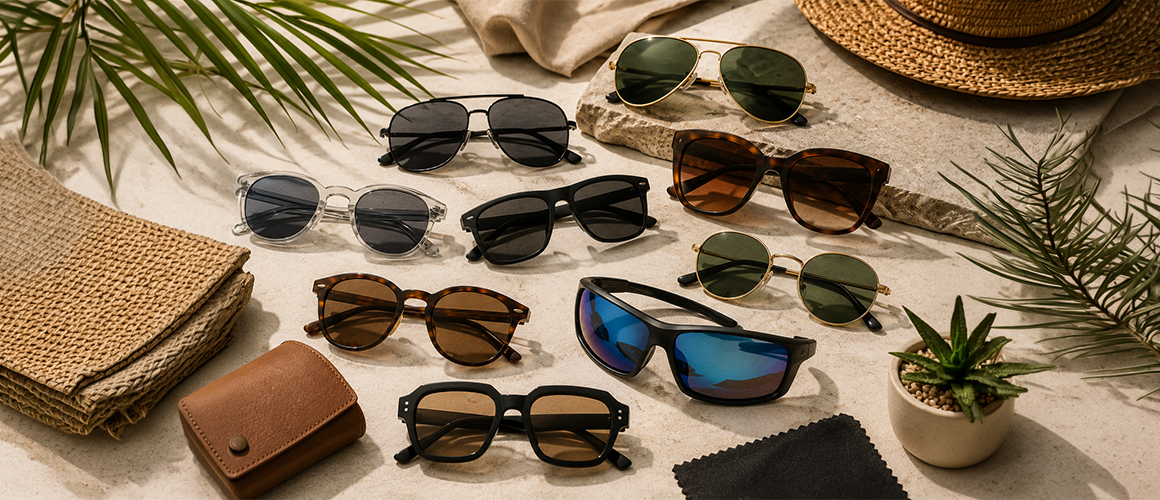
Ultimate Sunglasses Buying Guide for Men and Women in India
- Published on: 22 Jun 2026
- Sunglasses
India’s bright, sun-heavy climate makes sunglasses far more than a fashion accessory — they’re essential eye protection for most of the year. Yet many buyers focus only on looks and end up with sunglasses that don’t suit their face, offer little UV protection, or fade within months.
This guide covers everything you need to know before buying sunglasses in India — from face shape matching to lens technology — so your next pair looks good and actually protects your eyes.
Table of Contents
1. Quick Answer: What Makes a Good Pair of Sunglasses
2. Why UV Protection Matters in India
3. Choosing Sunglasses by Face Shape
4. Lens Types Explained
5. Frame Materials Compared
6. Sunglasses for Men vs Women: Style Differences
7. Sunglasses for Different Activities
8. How to Check Sunglasses Quality
9. FAQs
10. Conclusion
Quick Answer: What Makes a Good Pair of Sunglasses
A good pair of sunglasses should offer UV400 protection, match your face shape, and suit your daily activities. UV protection is the single most important factor — it shields your eyes from harmful ultraviolet rays year-round, especially important in India’s high-sun climate.
Why UV Protection Matters in India
Definition Box: UV400 refers to lenses that block 99-100% of UVA and UVB rays up to a wavelength of 400 nanometers — essentially blocking all harmful UV radiation from sunlight.
India receives high UV index levels for most of the year, particularly between 10 AM and 4 PM. Prolonged exposure without protection can contribute to:
• Premature eye strain and fatigue
• Increased risk of cataracts over time
• Sunburn on the delicate skin around the eyes
Always check for a UV400 or “100% UV protection” label — tinted lenses without UV coating offer no real protection and can actually cause your pupils to dilate more, letting in more harmful rays.
Choosing Sunglasses by Face Shape
|
Face Shape |
Recommended Frames |
Frames to Avoid |
|
Round |
Square or rectangular frames |
Round frames (add roundness) |
|
Square |
Round or oval frames |
Boxy square frames |
|
Oval |
Most shapes work — try oversized or cat-eye |
Very small frames |
|
Heart-shaped |
Aviators, rimless, light-colored frames |
Top-heavy/decorative frames |
|
Long/Oblong |
Wide frames with decorative temples |
Small, narrow frames |
Quick Tip: The general rule is to choose frame shapes that contrast with your face shape — angular faces suit rounder frames, and rounder faces suit more angular frames.
Lens Types Explained
• Polarized lenses: Reduce glare from reflective surfaces (water, roads, glass) — ideal for driving and outdoor activities
• Gradient lenses: Darker at the top, lighter at the bottom — good for driving as they reduce sky glare while keeping the dashboard visible
• Photochromic lenses: Automatically darken in sunlight and lighten indoors — convenient for those who move between environments often
• Mirrored lenses: Reflective coating that reduces brightness and adds a style statement, common in sports and fashion sunglasses
Polarized vs Non-Polarized — Quick Answer: Polarized lenses cut glare from reflective surfaces like water and roads, making them ideal for driving and outdoor sports. Non-polarized lenses are fine for general fashion use but offer less visual comfort in bright, reflective conditions.
Frame Materials Compared
|
Material |
Pros |
Best For |
|
Acetate |
Lightweight, wide color range, hypoallergenic |
Everyday fashion wear |
|
Metal (alloy/titanium) |
Durable, sleek, adjustable nose pads |
Classic and aviator styles |
|
TR90/Polymer |
Flexible, impact-resistant, lightweight |
Sports and active use |
|
Polycarbonate (lens) |
Shatter-resistant, lightweight |
Kids, sports, daily durability |
Sunglasses for Men vs Women: Style Differences
While sunglasses are increasingly unisex, certain trends differ:
Popular styles for men: Aviators, wayfarers, square frames, and sport wraparounds — generally bolder, larger frames.
Popular styles for women: Cat-eye, oversized round, rectangular, and butterfly frames — often with more variety in color and embellishment.
That said, frame size and shape should ultimately be guided by face shape rather than gender norms — many unisex styles like classic aviators and wayfarers suit both.
Sunglasses for Different Activities
• Driving: Polarized, gradient lenses with anti-glare coating
• Travel: Lightweight, foldable frames with scratch-resistant lenses
• Sports/Outdoor: Wraparound styles with polycarbonate lenses for impact resistance
• Daily/Casual: Versatile neutral-toned frames that pair with multiple outfits
How to Check Sunglasses Quality
Before buying, check for:
1. UV protection labeling — look for “UV400” or “100% UV protection”
2. Lens clarity — hold the lenses at arm’s length and check for distortion when moving them side to side
3. Frame fit — they should sit comfortably without pinching the temples or sliding down the nose
4. Hinge quality — smooth, sturdy hinges indicate better build quality
5. Lens color consistency — both lenses should be evenly tinted
FAQs
Q: What does UV400 mean on sunglasses?
UV400 means the lenses block 99-100% of UVA and UVB rays up to 400 nanometers, offering complete protection against harmful ultraviolet radiation from the sun.
Q: Are polarized sunglasses necessary for everyday use?
Not strictly necessary, but they significantly reduce glare from roads, water, and glass surfaces, making them especially useful for driving and outdoor activities.
Q: How do I know which sunglasses suit my face shape?
Identify your face shape first (round, square, oval, heart, or oblong), then choose frames that contrast with it — for example, angular frames for round faces and rounder frames for square faces.
Q: Can dark-tinted sunglasses without UV protection harm my eyes?
Yes — dark tints without UV coating can cause pupils to dilate more, allowing more UV rays to enter the eye, which can be more harmful than wearing no sunglasses at all.
Q: How often should I replace my sunglasses?
Sunglasses should be replaced if the lenses become scratched, the UV coating wears off, or the frame becomes loose or misaligned — typically every 1-2 years with regular use.
Conclusion
The right sunglasses combine three things: genuine UV protection, a frame shape that suits your face, and a lens type matched to your lifestyle. In India’s sunny climate, sunglasses aren’t optional — they’re essential eye care. Use this guide as a checklist the next time you shop, and you’ll end up with a pair that performs as well as it looks.
Explore our sunglasses collection at WatchNGlasses for styles designed for India’s everyday sun, from classic aviators to sporty wraparounds.
You May Also Like
Related Blogs
Best Premium Sunglasses for Daily Wear, Travel, and Outdoor Activities
Not all sunglasses are built for the same job. The pair you wear to the office isn’t necessarily the right one for a be...
Read More →
Top 10 First Copy Sunglasses Under Rs.1,500 India
Sunglasses are one of the most powerful style accessories a man can own. The right pair instantly upgrades any outfit —...
Read More →
Are First Copy Ray-Ban Sunglasses Safe for Eyes?
Ray-Ban is one of the most iconic eyewear brands in the world. From the classic Wayfarer to the timeless Aviator, Ray-Ban sun...
Read More →