
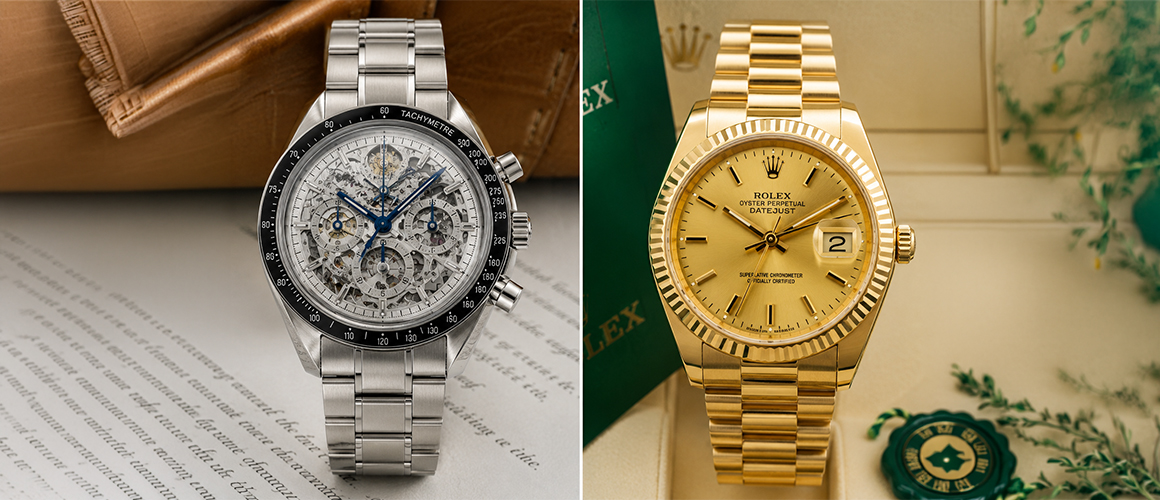
Quartz vs Automatic Watches: Which Is Worth Buying?
- Published on: 19 Jun 2026
- Watches
If you’ve ever shopped for a watch, you’ve probably come across the terms “quartz” and “automatic” — often with strong opinions attached to each. Watch enthusiasts love automatics for their craftsmanship, while everyday buyers often prefer quartz for its simplicity and accuracy. But which one is actually right for you?
This guide breaks down how each movement works, their pros and cons, and which type fits different lifestyles and budgets — so you can buy with confidence.
Table of Contents
1. Quick Answer: Quartz vs Automatic
2. What Is a Quartz Watch?
3. What Is an Automatic Watch?
4. Accuracy Comparison
5. Maintenance Differences
6. Cost Comparison
7. Which One Should You Buy?
8. FAQs
9. Conclusion
Quick Answer: Quartz vs Automatic
Quartz watches run on a battery and a quartz crystal, offering high accuracy, low maintenance, and affordability. Automatic watches are powered by the wearer’s wrist movement through an internal rotor, valued for craftsmanship but requiring more care and regular wear to stay accurate.
If you want a low-maintenance, accurate watch for daily use, choose quartz. If you appreciate mechanical engineering and don’t mind extra care, choose automatic.
What Is a Quartz Watch?
Definition: A quartz watch uses a battery-powered electronic oscillator regulated by a quartz crystal to keep time. The crystal vibrates at a precise frequency when an electric current passes through it, which the watch’s circuit converts into consistent timekeeping.
Key characteristics: - Requires a battery replacement every 1-2 years - Extremely accurate — typically within seconds per month - Lightweight movement, often more affordable - Minimal maintenance required
Quartz watches became widely popular in the 1970s and remain the most common movement type in everyday watches today due to their reliability and low cost of ownership.
What Is an Automatic Watch?
Definition: An automatic (or “self-winding”) watch is a mechanical watch powered by a rotor that spins with the natural motion of your wrist, winding the mainspring without a battery.
Key characteristics: - No battery required — powered by wrist movement - Visible mechanical movement, often viewable through a “display back” - Requires regular wearing (or a watch winder) to stay wound - Generally less accurate than quartz, typically losing or gaining a few seconds per day - Considered more “premium” due to craftsmanship and engineering
Accuracy Comparison
|
Factor |
Quartz |
Automatic |
|
Typical accuracy |
±15 seconds/month |
±5-20 seconds/day |
|
Power source |
Battery |
Wrist motion |
|
Needs winding |
No |
Yes (if not worn daily) |
|
Battery replacement |
Every 1-2 years |
Not applicable |
If precise timekeeping is your priority — for work schedules, meetings, or travel — quartz is the clear winner. Automatic watches can drift by seconds each day, which adds up over weeks.
Maintenance Differences
Quartz watches need very little upkeep beyond an occasional battery change, which is quick and inexpensive.
Automatic watches need more attention: - Should be worn regularly (ideally daily) to stay wound and accurate - If unworn for days, the watch stops and needs manual resetting - Periodic servicing (every 3-5 years) is recommended to maintain the internal mechanism - More sensitive to magnetic fields, which can affect accuracy
If you rotate between multiple watches or don’t wear one daily, a quartz watch is far more practical.
Cost Comparison
Generally, quartz watches are more affordable at every price tier because their movements are simpler and cheaper to manufacture. Automatic watches typically cost more due to the complexity of the mechanical movement and the craftsmanship involved in assembly.
That said, price isn’t the only consideration — many buyers choose automatic watches specifically for the mechanical appeal, not just timekeeping.
Which One Should You Buy?
Choose Quartz if you: - Want a reliable, low-maintenance daily watch - Travel frequently and need consistent accuracy - Prefer a lightweight, affordable option - Don’t want to think about winding or servicing
Choose Automatic if you: - Appreciate mechanical craftsmanship and engineering - Wear the same watch daily (or own a watch winder) - Are building a watch collection as a hobby - Don’t mind occasional servicing costs
There’s no universally “better” option — it depends entirely on how you’ll use and care for the watch.
FAQs
Q: Do automatic watches need batteries?
No. Automatic watches are powered entirely by the natural motion of your wrist, which winds an internal mainspring through a rotating weight called a rotor.
Q: Why do automatic watches lose time?
Automatic watches rely on mechanical components that are inherently less precise than quartz crystals, so small variations in timekeeping (seconds per day) are normal and expected.
Q: How often should I service an automatic watch?
Most manufacturers recommend servicing automatic watches every 3-5 years to clean, lubricate, and inspect the movement for long-term reliability.
Q: Is quartz considered a “lesser” watch?
Not at all — quartz movements are highly accurate, reliable, and used in many high-quality watches. The preference for automatic is more about mechanical appreciation than superiority.
Q: What happens if I don’t wear my automatic watch for a few days?
It will stop running once the mainspring fully unwinds, and you’ll need to manually wind and reset the time and date when you wear it again.
Conclusion
Both quartz and automatic watches have their place. Quartz offers unmatched accuracy and convenience for everyday wear, while automatic watches appeal to those who enjoy mechanical craftsmanship and don’t mind a bit of extra care. The right choice comes down to your lifestyle, how often you’ll wear the watch, and what you value most — precision or engineering artistry.
Explore our watch collection at WatchNGlasses to find a style and movement type that fits your everyday routine.
You May Also Like
Related Blogs
Branded First Copy Watches: Best Luxury Brands Available Online
Luxury watches are admired for their distinctive designs, sophisticated details, and timeless appeal. However, authentic luxu...
Read More →
Best First Copy Watches Under ₹3000 That Look Premium
Luxury watches often come with premium price tags that are beyond the reach of many buyers. Fortunately, best first copy watc...
Read More →
What Are First Copy Watches? Everything You Need to Know Before Buying (2026 Guide)
Buying a luxury watch has always been a dream for many people. Brands like Rolex, Omega, TAG Heuer, Tissot, Casio, Fossil, Mi...
Read More →
Trending Men’s Watches in 2026
What’s Driving Men’s Watch Trends in 2026? Men’s watches have never been more culturally relevant. After y...
Read More →